
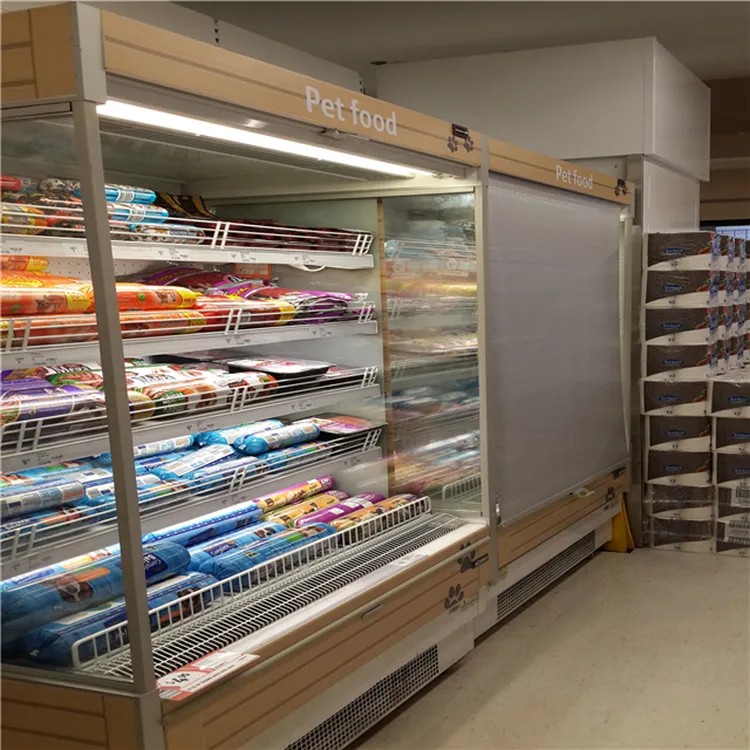
How Light Placement Creates Localized Heat Zones
Lighting systems in refrigerated cases emit radiant energy that interacts directly with food surfaces. When lights are positioned too close or directed improperly, this energy concentrates in specific areas.
This process contributes to heat transfer in refrigerated cases, where radiant heat from lighting overrides the cooling effect of circulating cold air in certain zones.
As a result, retailers may observe:
- Warm spots on product surfaces
- Uneven temperature distribution across shelves
- Faster quality deterioration in exposed items
- Reduced consistency in product freshness
How Retail Lighting Accelerates Protein Breakdown
Retail lighting systems are designed primarily for visual appeal, not food preservation. High brightness levels and long exposure durations increase the stress placed on food surfaces.
One of the most important evaluation tools in this context is food lighting performance metrics, which assess how lighting intensity, spectrum, and exposure duration affect food quality.
When these metrics are not properly optimized, prepared foods experience:
- Faster texture deterioration
- Reduced visual freshness
- Early-stage discoloration
- Decline in perceived quality
This is particularly critical in self-service and grab-and-go sections where food remains under lighting for extended periods.
These effects are subtle but accumulate over time, especially in high-traffic retail environments.
The Role of Wavelength and Light Intensity
Not all lighting behaves the same way. Different light sources emit varying levels of energy, which directly impacts food surface conditions.
A key factor here is wavelength impact on food, where higher-energy wavelengths contribute more to localized heating effects. Blue-rich light, for example, carries more energy and can slightly increase surface temperature when concentrated.
This becomes more significant in refrigerated environments where temperature stability is critical. Even small deviations can influence food quality perception.
Refrigerated Display Lighting and Temperature Stability
Modern stores rely heavily on refrigerated display lighting to enhance visual appeal. However, when lighting is not strategically positioned, it disrupts thermal balance inside the case.
This issue often affects food display case lighting, especially in systems where lighting is installed directly within or above chilled zones.
Improper placement can lead to:
- Disrupted airflow patterns
- Increased surface temperature fluctuations
- Reduced cooling efficiency near light sources
- Uneven product preservation across the display
These issues are often misinterpreted as refrigeration failure, when in reality, lighting configuration is the primary cause.
Surface Temperature vs Core Temperature in Food Products
One of the most important distinctions in refrigerated environments is the difference between surface and internal temperature. Lighting primarily affects the surface layer of food products.
This is where food lighting performance metrics become essential, as they help measure how lighting affects product surfaces over time.
Surface temperature increases can lead to:
- Faster moisture evaporation
- Changes in texture and appearance
- Reduced visual freshness
- Accelerated spoilage reactions in exposed layers
Even if core temperature remains stable, surface degradation can significantly impact customer perception.
Impact on Refrigeration Efficiency
When lighting raises surface temperatures, refrigeration systems must compensate for the added thermal load. This affects overall system performance and efficiency.
This is part of broader refrigeration load management, where additional heat sources increase cooling demand and energy consumption.
Over time, improper light placement can result in:
- Higher compressor workload
- Increased energy usage
- Reduced cooling consistency
- Greater temperature fluctuation risk
These effects reduce both operational efficiency and product quality stability.
Optimizing Light Placement for Stability
Proper lighting design can significantly reduce surface temperature fluctuations. The goal is to balance visibility with minimal thermal impact.
Best practices include:
- Positioning lights at an angle rather than directly above products
- Increasing distance between light sources and food surfaces
- Using diffused lighting instead of concentrated beams
- Selecting low-heat LED systems optimized for food environments
These strategies help maintain consistent cooling while preserving product visibility.
Why Retailers Often Overlook This Issue
Many retailers focus heavily on refrigeration settings while ignoring lighting placement. Since temperature fluctuations caused by lighting are subtle, they often go unnoticed until product quality issues appear.
However, integrating lighting design with refrigeration planning can significantly improve:
- Product freshness consistency
- Shelf life stability
- Visual merchandising quality
- Energy efficiency across display systems
For More Information
For deeper insights into food-safe lighting design and refrigerated display optimization, visit https://www.foodlighting.com. The platform provides advanced solutions for improving lighting placement, reducing thermal impact, and enhancing food preservation in retail environments.
Conclusion
Light placement plays a crucial role in controlling heat transfer in refrigerated cases and managing refrigerated display lighting effects on food surfaces. When properly designed, lighting supports both visual appeal and temperature stability, ensuring higher product quality, longer shelf life, and improved retail performance.